
If you’ve played hockey in Winnipeg for any length of time, you already know what separates the guys who make the jump from the guys who stay stuck. It’s not talent. It’s not ice time. It’s what happens from April to September when nobody’s watching.
I’ve been training hockey players in this city for years — from kids trying to crack a AAA roster all the way up to pros who’ve played in the NHL. And the pattern is always the same. The ones who commit to real off-season work come back in September looking like a completely different player. The ones who don’t? They spend the first six weeks of the season trying to catch up.
This is the guide I wish someone had handed me when I was coming up. Everything you need to know about off-season hockey training — what to focus on, what to skip, and how to structure your summer so you actually show up to tryouts ready.
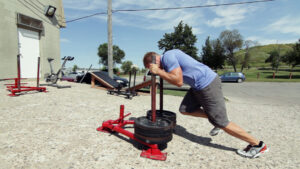
This is the biggest mistake I see hockey families in Manitoba make every single summer. The season ends, and within two weeks they’ve signed up for three power skating camps, a skills clinic, and a summer league. By August the kid has been on the ice five days a week for four months straight — and they’re no stronger, no faster, and usually nursing a sore hip or groin heading into tryouts.
I’m not saying ice time is useless. But if you’re trying to get genuinely faster, more explosive, and harder to knock off the puck, that development happens in the gym. Not on the ice.
Here’s why. Skating is essentially a series of single-leg power movements with high rotational demands through the core. Shot power comes from the ability to transfer force from the ground through your hips and trunk. Absorbing hits requires structural strength through your entire posterior chain. None of those qualities improve meaningfully by just skating more. They improve through progressive, structured hockey-specific strength and conditioning.
I’ve had players come in after a summer of five-days-a-week ice and test slower on their sprint times than when they left in April. Then the following year, they train with us three to four days a week in the gym with maybe one or two ice sessions, and they drop a full tenth off their 10-metre sprint. That’s not a coincidence — that’s what happens when you actually train the physical qualities that drive on-ice performance.
At our facility on Empress Street, we build every off-season program around four pillars: mindset, nutrition, movement, and recovery. Miss any one of them and you’re leaving results on the table. Here’s what each one actually looks like in practice.
Everything starts here. If you’re not getting stronger in the off-season, you’re wasting your time.
For hockey players, that means compound lifts — squats, deadlifts, lunges, bench press, rows — performed with real progressive overload. Not the same weight for the same reps every week. Actual planned progression where the demands increase over time.
But raw strength alone isn’t enough. You also need to convert that strength into power — the ability to produce force quickly. That’s where explosive work comes in: box jumps, med ball rotational throws, sled pushes, and hang cleans. We use Keiser pneumatic machines alongside traditional free weights at our facility, which lets us train both heavy strength and high-velocity power in the same session. It’s one of the reasons we get the results we do with our personal training clients.
A few specifics that matter for hockey: prioritize single-leg work (split squats, rear-foot-elevated lunges, single-leg RDLs), train hip abduction and adduction to protect against groin injuries, and don’t neglect rotational core work. Planks are fine, but they’re not enough. Hockey players need to produce and resist rotation under load.
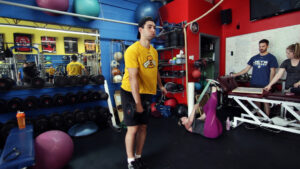
Strength without speed is just being slow and strong. Your off-season needs dedicated speed and agility work that mimics what actually happens during a game.
That means linear acceleration drills (10 to 30 metre sprints), lateral shuffles and crossover patterns, and reactive agility where you’re responding to a stimulus rather than just running a pre-set pattern. The conditioning piece should replicate the work-to-rest ratios of a hockey shift — repeated high-intensity efforts of 30 to 45 seconds with incomplete recovery.
One advantage of training in Winnipeg during the summer: you’ve got daylight until 9:30 PM in June and July. There’s no excuse not to get outside for sprint work at Assiniboine Park or a local track. Combine outdoor speed sessions with structured gym sessions through a sport-specific training program, and you’ve got a complete speed development system.
I can’t tell you how many players train hard all summer and completely undermine their results with garbage nutrition. Or the opposite — they eat clean but get the macros completely wrong for what they’re trying to accomplish.
Off-season nutrition for hockey players is different from in-season. You’re trying to add functional muscle mass, fuel high-intensity training sessions, and manage body composition — all at the same time. That requires enough protein to support muscle growth (most hockey players drastically undereat protein), sufficient carbohydrates to actually perform in the gym, and enough total calories to support recovery without adding unnecessary body fat.
This gets especially tricky with youth athletes. A 15-year-old who’s still growing has very different needs than a 25-year-old pro. A generic meal plan from Instagram isn’t going to cut it. That’s one of the reasons we integrate nutrition coaching directly into every athlete’s program rather than treating it as an add-on. When your strength coach and nutritionist are actually talking to each other, the results show up faster.
Every hockey player finishes the season banged up. Tight hips, sore groin, cranky lower back, shoulder that doesn’t feel quite right. During the season you manage these things because you have to. The off-season is when you actually fix them.
A proper off-season program includes athletic therapy to identify and correct the movement restrictions and soft tissue problems that built up over the year. We’re talking about hands-on assessment, targeted treatment, corrective exercises, and a mobility plan that addresses your specific issues — not a generic stretching routine you found on YouTube.
If you played through pain last season and you’re planning to just ignore it over the summer, you’re setting yourself up for a worse version of the same injury next year. Or a compensation injury somewhere else. Invest the time now. Your body will thank you in January when you’re still feeling strong while other guys are breaking down.
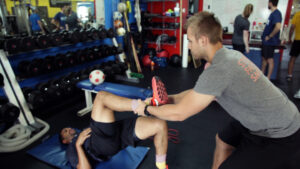
Every athlete’s program at our facility is different based on their assessment, but here’s a general framework that represents how we structure a productive training week:
The key word there is “framework.” The specific exercises, loads, sets, reps, and rest periods should change as the off-season progresses. Early phases build a strength base and clean up movement quality. Middle phases push toward power development and higher-intensity conditioning. The final phase tapers toward hockey-specific readiness as tryouts get closer. If your program looks the same in August as it did in May, something’s wrong.
This approach is consistent with periodization principles used by strength and conditioning professionals at every level of sport. The National Strength and Conditioning Association (NSCA) recommends structured, progressive program design as the foundation for athletic performance improvement — and that’s exactly what we build for every client.

If your kid is playing competitive minor hockey — whether it’s through Winnipeg Minor Hockey, a AAA program, or they’re eyeing the WJHL down the road — the off-season might be the most important developmental window of their year. But here’s what you need to understand: youth athletes are not small adults, and their training should not look like a scaled-down version of an adult program.
Our youth athlete training programs are built from the ground up for developing athletes. Every young player starts with a full movement assessment so we know exactly where they are physically. From there, we design age-appropriate programs that build foundational movement skills, develop confidence in the gym, and create the physical base that allows them to handle more advanced training as they mature.
For young hockey players specifically, we focus heavily on hip mobility (essential for developing a deep, powerful stride), core stability, landing mechanics, and general athletic coordination. We also spend time educating them on nutrition, sleep, and recovery — habits that will serve them whether they end up playing junior, NCAA, or just stay active and healthy for life.
And if you’re wondering whether strength training is safe for young athletes: it absolutely is, when it’s supervised and age-appropriate. The NSCA’s position statement on youth resistance training confirms that properly designed programs enhance strength, reduce injury risk, and improve motor skill performance in young people. We’ve followed those guidelines for years.
One thing I’ll say directly to parents: resist the urge to specialize your kid in hockey year-round at age 12. The research on this is overwhelming — early sport specialization increases overuse injury risk and burnout while providing no long-term competitive advantage. A 2022 systematic review in the Orthopaedic Journal of Sports Medicine found that delayed specialization was consistently associated with reduced injury risk and mostly associated with better performance at the professional level. Hockey Manitoba’s own “Better Athlete, Better Player” initiative echoes this — multi-sport participation and general athletic development is the path that builds durable, well-rounded athletes. That’s exactly what our youth programs are designed to support.
There are a lot of options in Winnipeg for off-season training. Some are great. Some are a waste of your money and time. Here’s what to actually look for.
Start with an assessment. Any facility worth your time will evaluate you before writing a program. If someone hands you a “hockey training plan” on day one without watching you move, walk out. A proper assessment includes functional movement screens, strength testing, and a real conversation about your goals and injury history.
Look for individualized programming. Group programs have their place — we run group training sessions ourselves — but your off-season strength program needs to be tailored to you. Your weaknesses aren’t the same as the guy next to you, and your program shouldn’t be either.
Check for integrated services. The best results happen when your strength coach, therapist, and nutritionist are actually coordinating. A facility that offers training, athletic therapy, and nutrition coaching under one roof saves you time and produces better outcomes than piecing together three different providers across the city.
Ask about their track record. Who have they trained? What levels? Results with real athletes — especially at the professional level — tell you more than any marketing campaign. At Richard Burr Fitness, we’ve worked with current and former NHL players alongside amateur and youth athletes. The principles are the same; the application just scales to the individual.
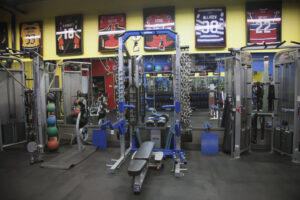
Pay attention to equipment. You can do a lot with a barbell and some dumbbells, but a dedicated performance facility with Keiser machines, sleds, plyo boxes, agility ladders, and proper recovery tools will give you access to training methods that a commercial gym simply can’t match.
Most competitive hockey seasons in Manitoba wrap up between March and May depending on the level. The best players take a week or two of complete rest — and they should, both physically and mentally — and then they get into structured training immediately.
If you wait until July to start, you’ve burned two to three months of development time. The players you’re competing against for roster spots in September started in April. That’s not meant to stress you out — it’s meant to be honest about what it takes. The off-season is long enough to make a real transformation if you use it properly. But you have to actually start.
We recommend booking your initial assessment as soon as your season ends. That gives us time to evaluate where you are, build your customized plan, and get you into a solid rhythm before summer hits full stride.
Whether you’re a minor hockey player getting ready for AAA tryouts, a junior athlete chasing a WHL roster spot, or an adult beer leaguer who’s tired of getting outworked by guys ten years younger — the off-season is where the real separation happens.
At Richard Burr Fitness, we’ve helped hockey players at every level train smarter and compete harder. Our facility at 1133 Empress Street in Winnipeg brings everything together under one roof: hockey-specific training, personal training, athletic therapy, nutrition coaching, and youth athlete programs. Every program starts with a complimentary assessment so we build around your goals — not a template.
Book your free assessment today or call us at (204) 782-3639. Let’s make this your best off-season yet.